01 Gallery 01 · God Speaks
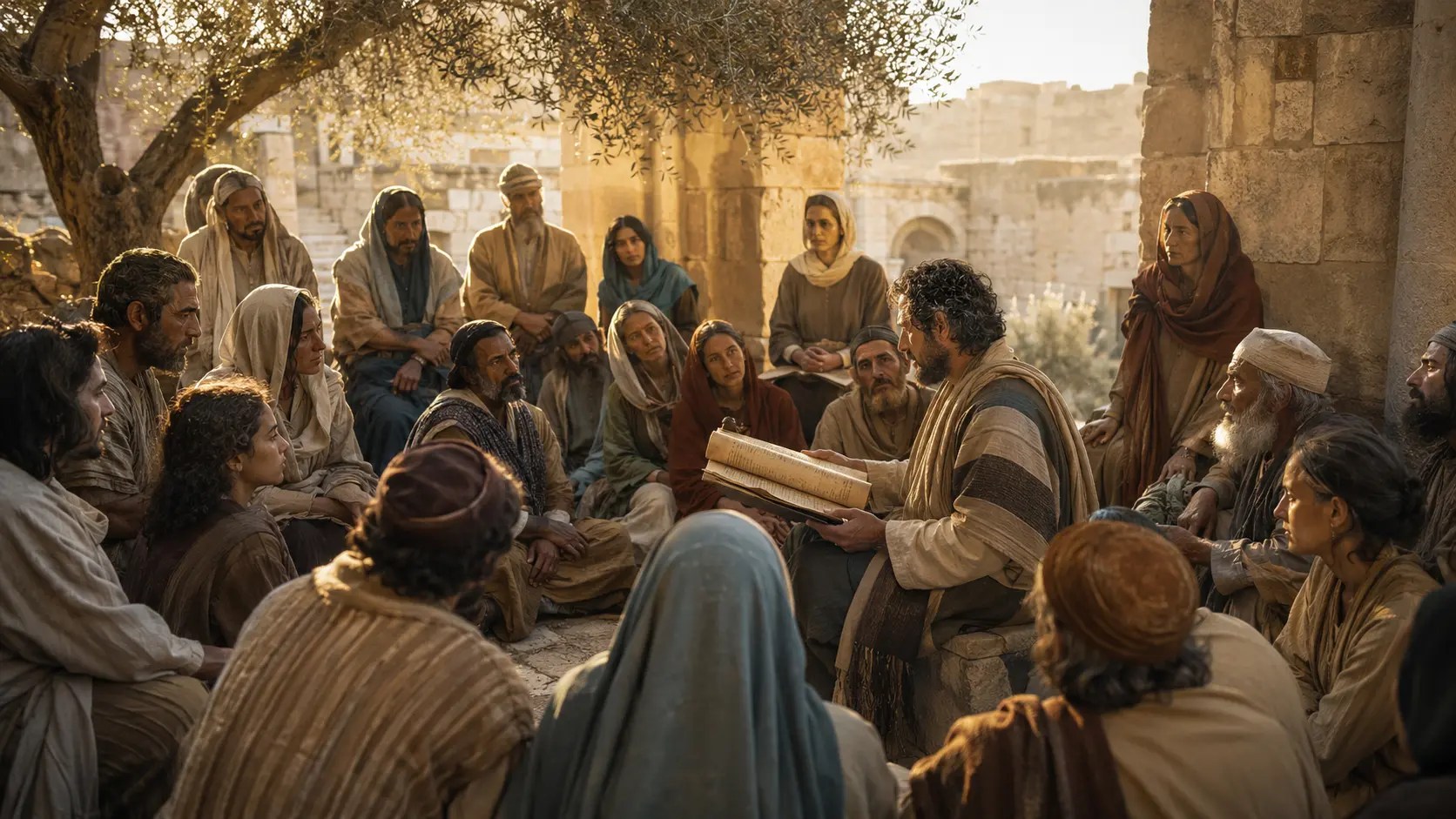
Before there was a manuscript, there was a voice.
Where does Scripture’s history truly begin?Evidence & Sources+
Exodus 24:4–7 · Deuteronomy 31:9–13 · Jeremiah 36 · Luke 1:1–4 · Colossians 4:16
Explicit Scripture establishes revelation, writing and public reading. The precise production history of many biblical books remains a historical reconstruction.
God reveals
Scripture begins with God making Himself known—not humanity discovering Him unaided.
Witnesses receive
Prophets and apostles speak and write within history, using real languages and literary forms.
Communities hear
The words are read publicly, remembered, obeyed and entrusted to another generation.
Moses writes covenant words and gives them to Israel’s priests. Prophets preserve visions and oracles. Luke investigates testimony. Paul dictates letters to churches. John writes what he has seen and heard.
In each case the manuscript matters because the message came first. Christians do not worship ink, parchment or paper. They receive through these ordinary materials the testimony God chose to give.
The biblical pattern is spoken revelation becoming written witness, then public reading. Preservation serves proclamation: the words are kept so that they may be heard.
Follow the biblical pattern
Exodus 24:4–7 · Deuteronomy 31:9–13 · Jeremiah 36 · Luke 1:1–4 · Colossians 4:16 · 1 Thessalonians 5:27 · Revelation 1:3
02 Gallery 02 · The First Copies
The originals travelled by being copied.
How did a fragile ancient text outlive the material on which it was written?Evidence & Sources+
Documented fact: the autographs are not known to survive. Strong consensus: comparison across independent copies allows copying differences to be identified.
The first written document
Read by another community
A distributed tradition
Evidence visible today
At the scribe’s desk
Copying was both careful and human.
Professional and trained scribes wrote by hand, checked lines, corrected errors and sometimes added notes. They could also miss a word, repeat a line, transpose letters or clarify an unfamiliar expression.
Multiplicity is what makes mistakes visible. When independent copies disagree, comparison exposes the difference rather than concealing it.
The autographs are not known to survive.
Our text is reconstructed from a distributed manuscript tradition.
A copyist’s precise motive is often a reasoned reconstruction, not a fact we can observe.
03 Gallery 03 · The Old Testament Manuscripts
One ancient Scriptures. Several streams of witness.
What does each Old Testament witness allow us to see?Evidence & Sources+
Deuteronomy 17:18 · 2 Kings 22–23 · Ezra 7:6, 10 · Nehemiah 8
Documented witnesses demonstrate both substantial stability and real textual plurality in the Second Temple period.
Septuagint
Ancient Jewish translation begun before Christ. It sometimes reflects a Hebrew form different from the later Masoretic tradition and shaped the language of many New Testament quotations.
Dead Sea Scrolls
Manuscripts from roughly the third century BC to first century AD. They reveal both remarkable continuity and genuine textual plurality before the medieval codices.
Pentateuch
A distinct Torah tradition preserved by the Samaritan community, agreeing at points with the Septuagint and differing at others.
Aleppo & Leningrad
Medieval codices preserving a meticulously annotated Hebrew tradition. The Leningrad Codex is the oldest complete manuscript of the Hebrew Bible and the base of major modern editions.
The honest conclusion is both stability and plurality: faithfully transmitted, yet not preserved in only one surviving textual form.
Examine the evidence
Editors ordinarily use the Masoretic Text as their base while consulting the Dead Sea Scrolls, Septuagint, Samaritan Pentateuch, Syriac Peshitta, Latin Vulgate and other evidence where the Hebrew is difficult or another reading may be earlier.
04 Gallery 04 · The New Testament Begins
The evidence spreads across languages, centuries and continents.
Why does more evidence produce both more variants and more confidence?Evidence & Sources+
Luke 1:1–4 · John 20:30–31 · 1 Thessalonians 5:27 · Revelation 1:3
The categories of papyri, majuscules, minuscules and lectionaries are documented catalogue classifications. Totals remain date-sensitive.
Papyri
Early, often fragmentary
Majuscules
Capital-script codices
Minuscules
Later running script
Lectionaries
Readings for worship
Versions
Syriac, Latin, Coptic & more
Church Fathers
Quotations in sermons and books
The New Testament autographs were written in first-century Koine Greek. What survives is not a chain ending in one master copy, but a network of witnesses—most partial, some extensive, all located within a history.
About 5,800 Greek witnesses are catalogued, but this does not mean 5,800 complete New Testaments. Counts change as fragments are joined, manuscripts are reclassified and new evidence enters the official catalogue.
A raw variant total grows with the number of comparisons. The real questions are whether a difference is meaningful, viable and unresolved—and whether it changes what Christians believe.
05 Gallery 05 · The Great Codices
Four witnesses. Four histories. No secret manuscript.
Why do these codices receive so much attention?Evidence & Sources+
Dates are scholarly estimates based on palaeography and codicology. Importance does not mean automatic correctness in every reading.
Codex Vaticanus
Held in the Vatican Library. One of the oldest substantial Greek Bibles, especially important for the Septuagint and New Testament.
Rome · incomplete at its endCodex Sinaiticus
Discovered in stages at St Catherine’s Monastery and now digitally reunited across institutions. Contains the earliest complete New Testament.
Sinai · widely accessible onlineCodex Alexandrinus
A major Greek Bible presented to King Charles I in 1627 and now held by the British Library.
Alexandria tradition · substantial contentsCodex Bezae
A Greek–Latin manuscript with a distinctive form of the Gospels and Acts, valuable precisely because it preserves a different textual history.
Cambridge · bilingual witness06 Gallery 06 · The Age of the Codex
Christians helped turn the scroll into a book.
Why did the codex become characteristic of early Christianity?Evidence & Sources+
Strong historical pattern: Christians adopted the codex unusually early. The reasons were probably practical and social; no single motive is explicitly documented for every community.
Scroll
- Continuous roll
- Usually one side of the material
- Slower movement between passages
- Natural home of many ancient works
Codex
- Leaves bound at one edge
- Writing on both sides
- Faster reference and comparison
- Multiple writings gathered together
Christians did not invent the codex, but they adopted it unusually early and extensively. A bound collection made it easier to place four Gospels together, move between passages and carry more text in one object.
The change also made the shape of the canon increasingly visible. A manuscript containing multiple writings embodied their shared use before any printing press could standardise an order.
This is a strong historical pattern, not proof that every early Christian community adopted the codex for one identical theological reason.
07 Gallery 07 · Christianity Under Rome
Empires could burn books. They could not silence the witness.
What survived when possessing Scripture could become dangerous?Evidence & Sources+
Matthew 24:9 · Revelation 1:9; 6:9–11
The Diocletianic orders against Christian Scriptures and Constantine’s later commissioning of copies are historically attested. Constantine did not determine the original contents of Christian Scripture.
Nero
A brutal local persecution in Rome
Domitian
Pressure and imperial claims shape the setting of Revelation
Diocletian
The Great Persecution orders Scriptures surrendered and destroyed
Edict of Milan
Christian worship is legalised
Constantine
Churches and copies receive imperial support
Constantine did not create the Bible.
Christian writings, quotations, collections and debates about recognised books existed centuries before him. Constantine legalised Christianity, supported the Church and commissioned copies after persecution. That changed the conditions of preservation—not the identity of Jesus or the origin of apostolic Scripture.
08 Gallery 08 · From Manuscripts to Printing
The text enters the age of movable type.
How did several printed editions become what later readers called the Textus Receptus?Evidence & Sources+
Edition dates and printed lineages are documented. ‘Textus Receptus’ names a related stream of printed editions, not one ancient manuscript.
A revolution in replication
One setting of type could produce many substantially identical copies.
Printing did not end textual decisions. It concentrated them. An editor had to choose which available manuscript reading would enter the printed page.
Complutensian Polyglot
Printed first, published later.
Erasmus
Five editions; first printed Greek New Testament to reach the market.
Stephanus
Four editions; 1551 introduces the familiar verse numbers.
Beza
Multiple editions; 1598 strongly influences KJV translators.
Elzevir
The publisher’s phrase textum receptum gives the later family its name.
09 Gallery 09 · The English Bible Story
The King James Bible stands within a family—not outside history.
How did one English Bible prepare the language of the next?Evidence & Sources+
Publication dates, revision relationships and officially reported committee figures are documented. Committee totals are not directly comparable because publishers count translators, reviewers and consultants differently.
Wycliffe
Handwritten English from the Latin Vulgate
Tyndale
Printed New Testament from Greek; foundational English phrasing
Coverdale
First complete printed English Bible
Matthew Bible
Tyndale and Coverdale combined
Great Bible
First officially authorised English Bible
Geneva Bible
Popular study Bible produced by English exiles
Bishops’ Bible
Official revision used as the KJV base
King James Version
A monumental company revision drawing on the whole tradition
The KJV accurately situated
Extraordinary achievement.
Historically located.
About forty-seven participating scholars worked in six companies at Westminster, Oxford and Cambridge. The Bishops’ Bible was their formal base; Tyndale, Geneva, Rheims and other sources shaped their work.
For the New Testament they used printed Greek editions in the Erasmus–Stephanus–Beza stream, particularly Beza’s 1598 edition. They did not possess later-discovered papyri, the published Sinaiticus or modern access to the global manuscript tradition.
Translation Explorer
The English Bible story
continues.
Open any translation to see where it belongs within the same manuscript history. Committee figures reflect each publisher’s own method of counting and are therefore informative—not directly comparative.
1611King James VersionFormal, literary company revision+
1611
Formal, literary company revision
Masoretic Hebrew tradition through the printed rabbinic Bibles available to the translators; ancient versions consulted
Printed Greek editions in the Erasmus–Stephanus–Beza stream, especially Beza 1598
54 nominated; approximately 47 participated in six companies
Commissioned after the Hampton Court Conference to provide a new church Bible, revising the Bishops’ Bible while consulting earlier English translations.
- Byzantine manuscript tradition↓
- Erasmus↓
- Stephanus↓
- Beza↓
- KJV
1971New American Standard BibleFormal equivalence+
1971 · 1995 · 2020
Formal equivalence
Biblia Hebraica editions of the Masoretic Text, with ancient witnesses consulted
Contemporary Nestle–Aland critical editions for each revision
42 scholars named on Lockman’s 1977 roster; later updates used additional review teams
Developed from the American Standard Version tradition to combine close attention to Hebrew and Greek form with current English.
- Earlier manuscript discoveries↓
- Critical Hebrew & Greek editions↓
- American Standard Version↓
- NASB
1978New International VersionMediating / meaning-based, balancing accuracy and natural English+
1978 · 2011
Mediating / meaning-based, balancing accuracy and natural English
Masoretic Text with Dead Sea Scrolls and ancient versions considered
Contemporary eclectic Greek critical text
More than 100 scholars; continuing 15-member Committee on Bible Translation
Created as a fresh interdenominational translation for clear contemporary English rather than as a revision of one older English Bible.
- Earlier manuscript discoveries↓
- Modern Hebrew & Greek editions↓
- Independent translation↓
- NIV
1982New King James VersionFormal equivalence in contemporary English+
1982
Formal equivalence in contemporary English
Masoretic Text, with comparison to other ancient witnesses
Textus Receptus in the text; Majority and modern critical readings documented in notes
More than 130 scholars, editors and church leaders
Commissioned in 1975 to preserve the literary continuity of the KJV while replacing archaic English and supplying transparent textual notes.
- Byzantine manuscript tradition↓
- Textus Receptus↓
- KJV revision tradition↓
- NKJV
1996New Living TranslationDynamic equivalence, using formal renderings where they remain clear and natural+
1996 · 2004
Dynamic equivalence, using formal renderings where they remain clear and natural
Masoretic Text as represented in Biblia Hebraica Stuttgartensia; Dead Sea Scrolls, Septuagint, Samaritan Pentateuch, Syriac and Latin witnesses consulted
UBS Greek New Testament, 4th revised edition, and Nestle–Aland 27; significant departures are identified in textual notes
90 leading Bible scholars, working with senior translators and English stylists
Developed as a fresh translation from Hebrew, Aramaic and Greek to communicate the meaning and effect of the ancient text in clear contemporary English, especially for reading and hearing aloud.
- Earlier manuscript discoveries↓
- BHS · UBS 4 · Nestle–Aland 27↓
- Independent translation from the original languages↓
- NLT
2001English Standard VersionEssentially literal+
2001
Essentially literal
Biblia Hebraica Stuttgartensia; Dead Sea Scrolls and ancient versions consulted in difficult cases
Nestle–Aland / UBS critical text, with occasional independently judged readings
More than 120 translators, reviewers and advisers; 14-member Oversight Committee
A revision in the Tyndale–KJV–RSV lineage seeking word-for-word precision, literary quality and continuity with historic English Bible language.
- Earlier manuscript discoveries↓
- Nestle–Aland / UBS↓
- RSV 1971↓
- ESV
2005New English TranslationAccurate, readable and transparent; decisions explained in extensive notes+
2005 · 2019
Accurate, readable and transparent; decisions explained in extensive notes
Best available Hebrew and Aramaic editions, with ancient witnesses evaluated
Modern eclectic Greek text; notes explicitly document differences from Nestle–Aland
More than 25 biblical scholars, supported by editors and public review
Created digitally as a new translation whose extensive translators’ notes allow readers to examine the evidence and reasoning behind decisions.
- Earlier manuscript discoveries↓
- Modern critical editions↓
- Digital public review↓
- NET
2017Christian Standard BibleOptimal equivalence+
2017
Optimal equivalence
Biblia Hebraica Stuttgartensia, 5th edition
Nestle–Aland 28 and UBS 5, corrected edition
100 scholars, editors, stylists and proofreaders reported for its HCSB foundation
A substantial revision of the 2004 HCSB, designed to balance linguistic precision with clarity for reading, teaching and public use.
- Earlier manuscript discoveries↓
- Nestle–Aland 28 / UBS 5↓
- HCSB↓
- CSB
10 Gallery 10 · Earlier Manuscripts Come to Light
Scholarship gains an earlier and wider horizon.
Did scholars change the Bible—or gain more evidence with which to examine its history?Evidence & Sources+
Documented fact: nineteenth- and twentieth-century editors gained wider access to earlier and more geographically distributed witnesses. Modern editions do not simply reproduce Westcott and Hort.
Griesbach
Grouped textual tendencies and weighed readings instead of counting blindly.
Lachmann
Attempted to move behind the familiar printed text to the earlier recoverable tradition.
Tischendorf
Published manuscripts and brought Codex Sinaiticus to scholarly attention.
Westcott & Hort
Gave decisive weight to early witnesses; influential, but not identical to present method.
Nestle & Aland
Built an increasingly evidence-rich critical text and apparatus.
UBS
Presents variants especially relevant to translators with confidence assessments.
Later editors did not discover Christianity’s Scriptures for the first time. They gained broader access to evidence that was earlier, geographically wider or previously difficult to consult.
Modern editions are eclectic: they do not mechanically reproduce one manuscript or vote by numerical majority. Each reading is evaluated within the history that best explains the others.
The method remains revisable because scholarship is accountable to evidence—not because the text is unknowable.
11 Gallery 11 · Why Some Verses Differ
Open the footnote. Look at the evidence.
What happened—and does any essential Christian doctrine disappear?Evidence & Sources+
The presence and location of variant readings are documented. Explanations of how a reading arose are often reasoned reconstructions and should be stated as such.
Date · geographical spread · manuscript relationships · quality of witnesses
Authorial style · immediate context · known scribal habits · explanatory power
Which reading most plausibly explains how the others arose?
01Romans 8:1A shorter ending+
The earliest recoverable form ends after ‘in Christ Jesus.’ Later witnesses add wording found in verse 4.
A familiar Pauline phrase was probably expanded to clarify the verse and harmonise it with its immediate context.
The call to walk by the Spirit remains explicit in Romans 8:4 and throughout the chapter.
02Acts 8:37A baptismal confession+
The confession appears in later Greek manuscripts and the Latin tradition but is absent from important early Greek witnesses.
An early baptismal confession may have entered the narrative from church practice or a marginal explanation.
Faith in Jesus is explicitly joined to baptism elsewhere in Acts; no doctrine depends on this verse alone.
03John 5:4Why the water moved+
The angelic explanation is missing from the earliest Greek witnesses and appears in several later forms.
A copyist likely supplied the traditional explanation for the sick man’s words in verse 7.
Jesus—not the pool’s mechanism—is the theological centre of the healing.
04Mark 16:9–20The longer ending+
The earliest complete Greek codices end at 16:8; the longer ending is ancient and widely transmitted, while other endings also survive.
The abrupt ending prompted early attempts to preserve or supply remembered resurrection material.
Christ’s resurrection, appearances and commission are abundantly attested elsewhere.
05John 7:53–8:11The woman accused+
The account is absent from the earliest witnesses, moves location in some manuscripts and has a distinctive transmission history.
An ancient Jesus tradition appears to have circulated independently before entering John’s manuscript tradition.
Jesus’ mercy toward sinners and His call to leave sin are explicit across the Gospels.
061 John 5:7–8The heavenly witnesses+
The Trinitarian wording is absent from almost all Greek manuscripts before the late medieval period and entered Erasmus’s later printed text under pressure.
A Latin interpretive gloss moved into the text and then into a small number of Greek witnesses.
The Trinity does not rest on this reading; Father, Son and Spirit are taught throughout the New Testament.
Variants can affect individual texts and arguments. No essential Christian doctrine depends solely on a reading that disappears when disputed passages are set aside.
12 Gallery 12 · Why Christians Can Trust the Bible
Confidence grows when the evidence is open.
What kind of preservation does the history actually reveal?Evidence & Sources+
Isaiah 40:8 · Matthew 5:18; 24:35 · 1 Peter 1:23–25
Confessional conclusion: God has preserved His Word. Historical conclusion: the surviving evidence displays preservation through a distributed and openly examinable tradition.
Jesus Christ
Manuscripts
Thousands of Greek, Hebrew and versional witnesses
Ancient translations
Independent evidence across languages
Church Fathers
Quotations locating readings in time and place
Archaeology
Material context for the biblical world
Dead Sea Scrolls
A millennium-deep comparison for the Hebrew Bible
Digital scholarship
Open images, catalogues and global comparison
The manuscript tradition is unusually rich and transparent. Its abundance produces many observable variants—but it also makes those variants detectable and testable.
Preservation does not mean that every scribe copied without error. It means the textual tradition was not reduced to one vulnerable line of custody. Readings survived across places, languages and communities.
Scripture’s promise that God’s Word endures grounds Christian confidence in His faithfulness. History shows the ordinary, distributed means through which that endurance became visible.
What preservation passages explicitly teach
Isaiah 40:8 · Matthew 5:18; 24:35 · 1 Peter 1:23–25 affirm the endurance and authority of God’s Word. They do not explicitly identify one future printed edition, language or manuscript family as the sole means of preservation.
13 Gallery 13 · The Final Gallery
The artifacts were preserved so the voice could still be heard.
What is the Bible’s history ultimately for?Evidence & Sources+
Luke 24:25–27 · John 5:39–40; 20:30–31 · 2 Timothy 3:14–17
Explicit Scripture: the written witness leads readers to Christ. Confessional conclusion: preservation serves proclamation and faith.
Covenant scrolls · apostolic witness
Dead Sea Scrolls
Septuagint tradition · Codex Alexandrinus
Codex Sinaiticus
Codex Vaticanus · Latin tradition
Erasmus · 1516
Geneva Bible · 1560
English Bible tradition · KJV 1611
Modern manuscript catalogue and research
Jerusalem, Qumran, Alexandria, Sinai, Rome, Basel, Geneva, London and Münster are not competing centres of faith. They are locations in one long and examinable history.
The scrolls, codices, printed editions and translations are not the destination. They are witnesses carrying the prophetic and apostolic testimony across time.
That testimony announces Jesus Christ: promised in the Scriptures, crucified for sins, raised from the dead, reigning now and coming again.